








As a medical practice manager, you balance two critical priorities every single day: providing exceptional patient care and protecting sensitive patient data. In a world of 24/7 communication, managing after-hours calls, emergencies, and routine inquiries can feel overwhelming. The fear of a missed critical message is matched only by the terror of a potential data breach and the staggering HHS fines that follow. How can you outsource your calls to ensure constant availability without risking patient privacy or violating complex federal regulations? This is the central challenge for modern healthcare providers.
The solution lies in a specialized partner, but not just any answering service will do. True peace of mind comes from understanding that compliance isn’t just a document you sign—it’s a secure communication lifecycle, built on specialized technology and 24/7 vigilance. This guide will walk you through the essential components of a truly HIPAA compliant medical answering service, providing a clear framework for protecting your patients, your staff, and your practice in 2026 and beyond.
What is a HIPAA Compliant Medical Answering Service?
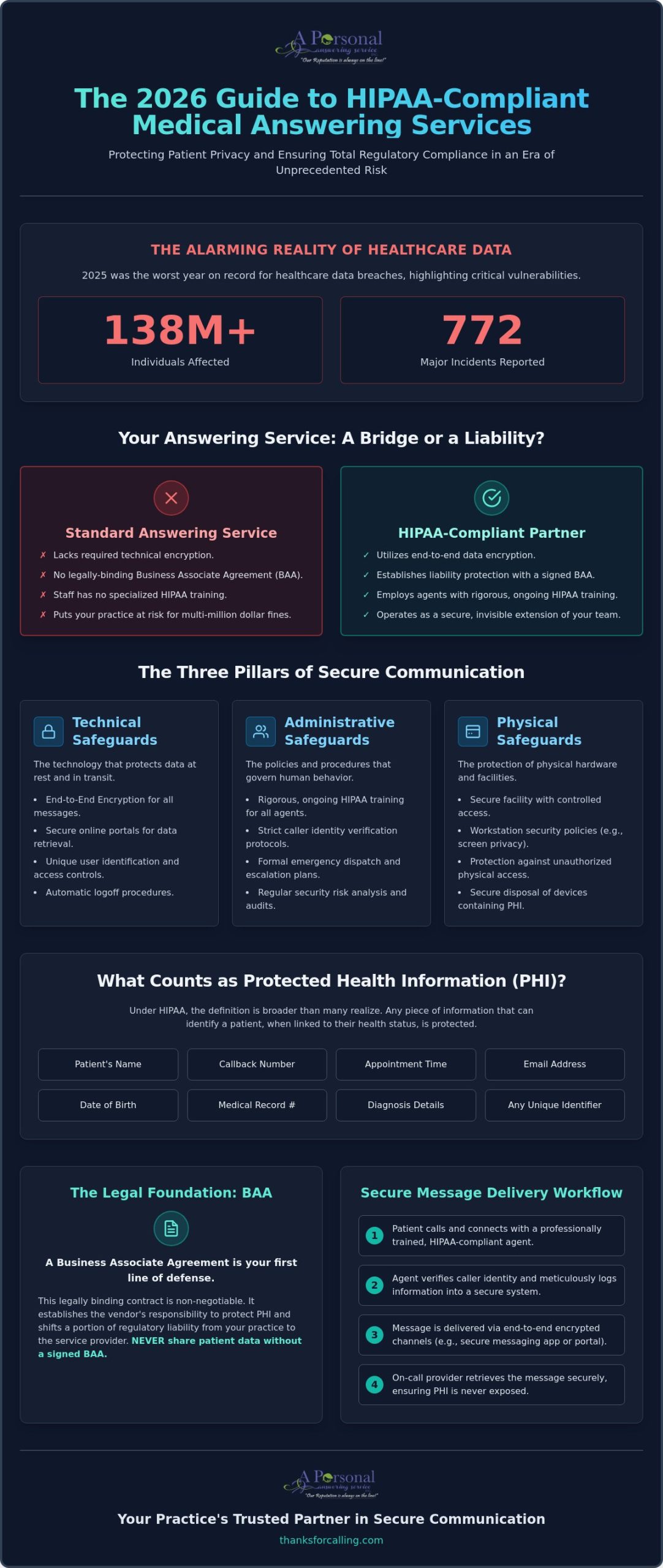
A HIPAA compliant medical answering service is far more than a simple call-forwarding system. It is a specialized communication partner, staffed by highly trained agents who understand the legal and ethical weight of handling Protected Health Information (PHI). They operate under a strict set of federal guidelines to ensure every patient interaction—from a simple appointment query to an urgent after-hours emergency—is managed with total security and confidentiality. This partnership is legally formalized through a crucial document: the Business Associate Agreement (BAA).
Unlike standard answering services, which can expose your practice to significant liability, a compliant service acts as a secure extension of your own team. Their agents are trained not just in professional phone etiquette but also in the nuances of medical communication, serving as a compassionate and competent first point of contact for your patients. They understand that even a name and callback number constitute PHI and must be protected with the same rigor as a detailed medical history.
- A specialized communication partner trained to handle Protected Health Information (PHI) securely.
- The legal necessity of the Business Associate Agreement (BAA) in 2026.
- Why standard answering services are a liability for healthcare providers.
- The role of the live agent as a compassionate first point of contact.
The Legal Foundation: The BAA
A Business Associate Agreement (BAA) is a legally binding contract that outlines the responsibilities of a third-party vendor (the “business associate”) in protecting the PHI they handle on behalf of a healthcare provider. This single document is the cornerstone of HIPAA compliance, contractually obligating your answering service to uphold the same security standards you do and effectively shifting liability for their handling of your data. You should never, under any circumstances, grant a third party access to patient information without a signed BAA in place. At A Personal Answering Service, we simplify this crucial step by proactively providing a BAA as a standard part of our onboarding process, ensuring your practice is protected from day one.
Understanding PHI in 2026
In the context of a phone call, Protected Health Information (PHI) includes any information that can be used to identify a patient, combined with details about their health, healthcare services, or payment for those services. Many practices make the mistake of thinking PHI is limited to diagnoses or test results. However, even a patient’s name linked to a callback number or an inquiry about a specific physician is considered PHI. The consequences of non-compliance are severe, ranging from multi-million dollar fines levied by the Department of Health and Human Services (HHS) to irreparable damage to your practice’s reputation. A compliant partner understands these nuances and builds their entire workflow around protecting every piece of data.
The Three Pillars of Secure Patient Communication
True HIPAA compliance is not a single feature; it’s a comprehensive security posture built on three distinct but interconnected pillars. These safeguards work in concert to create an impenetrable fortress around your patient data, ensuring that every message, call recording, and interaction is protected from unauthorized access. This multi-layered approach is what transforms a standard service into a “safe pair of hands” for your practice’s most sensitive information.
- Technical Safeguards: This pillar focuses on the technology used to protect electronic PHI (ePHI). It includes end-to-end encryption for all messages and data, both in transit and at rest. This means that from the moment an agent types a message to the moment you read it in your secure portal, the information is unreadable to anyone without authorized access.
- Administrative Safeguards: These are the policies and procedures that dictate how your data is managed. This includes rigorous, ongoing HIPAA training for all call center agents, strict access control protocols to limit who can view PHI, and formal contingency plans for data recovery in case of an emergency.
- Physical Safeguards: This pillar governs the physical security of the facilities and equipment where your data is stored and handled. It involves measures like secure, access-controlled data centers, restricted entry to agent workstations, and policies that prevent agents from using personal devices like cell phones in the call handling area.
Rigorous Agent Training Protocols
Technology is only as effective as the people using it. That’s why intensive agent training is a critical administrative safeguard. Our agents undergo comprehensive training on how to verify a caller’s identity without asking for excessive information, how to handle emotionally charged emergency calls with professional decorum, and how to recognize and report potential security risks. This initial training is reinforced with ongoing compliance audits and continuous education to ensure our standards never slip, making our agents a true, trustworthy extension of your team.
Data Encryption and Storage
When an agent takes a message, where does it go? A compliant service never uses standard, unencrypted channels like SMS or email to transmit PHI. There is a world of difference between a standard text message, which can be easily intercepted, and a secure, encrypted message delivered via a dedicated portal or application. All data, including call recordings and agent notes, must be stored on encrypted servers in a secure data center. Furthermore, a robust system maintains a clear audit trail for every single patient interaction, logging who accessed the information, what they did, and when they did it. This creates a transparent and accountable record for every piece of data handled.
How Secure Message Delivery Works: The Workflow
To truly appreciate the value of a HIPAA compliant answering service, it’s essential to understand the secure lifecycle of a patient message. Competitors often speak vaguely about “secure messages,” but the actual workflow is what separates a truly compliant provider from one that merely pays lip service to security. The process is a carefully choreographed sequence of events designed to capture information accurately, transmit it securely, and ensure it reaches the right person without delay or risk of exposure.
This workflow is designed to be both highly secure and incredibly efficient, ensuring that patient care is never compromised while compliance is always maintained.
- The Patient Call: The process begins when a patient calls your practice after hours. A live agent answers promptly, following a custom script developed in consultation with your office. This script ensures all necessary information is gathered consistently and professionally.
- Secure Data Entry: The agent enters the caller’s information and message directly into a centralized, HIPAA-compliant software platform. This system is fully encrypted and access-controlled, preventing any unauthorized viewing of the data.
- The Secure Handoff: The system then automatically notifies the designated on-call physician or staff member according to your specific protocols. Critically, this notification does not contain any PHI. Instead, it’s a simple alert prompting the recipient to log in to the secure portal.
- Secure Message Retrieval: The physician or staff member logs into the web-based portal or mobile app using secure credentials. Here, they can view the full message, listen to call recordings, see time stamps, and access agent notes, all within a protected environment.
The Secure Online Portal Advantage
Why is logging into a portal so much safer than receiving a text message with patient details? A secure portal creates a closed-loop communication system. Unlike email or SMS, which travels across public networks and can remain on unsecured local devices, a portal ensures that PHI never leaves the protected server environment. This gives you real-time, centralized access to all patient messages, call history, and agent notes. Furthermore, platforms like the one offered by A Personal Answering Service allow you to manage your on-call schedules directly, ensuring the right person is always notified without complex and error-prone manual processes.
Emergency Dispatch and Triage
In a medical setting, not all calls are created equal. A key function of a compliant answering service is the ability to triage calls based on urgency. Agents are trained to use your custom protocols to distinguish between routine inquiries (like appointment requests or billing questions) and urgent medical needs that require immediate physician attention. For after-hours emergencies, a specific protocol is triggered for immediate physician notification, often involving direct patch-through calls or persistent alerts until the message is acknowledged. This ensures zero lag time in critical patient care scenarios, providing a vital safety net for your practice and your patients.
Evaluating Your Provider: A HIPAA Compliance Checklist
Choosing the right partner to handle your patient communications is a decision with significant consequences. To make an informed choice, you need an actionable framework for auditing any potential answering service provider. A truly compliant service will be transparent and forthcoming about its security practices. Use this checklist during your evaluation process to cut through marketing jargon and assess a provider’s genuine commitment to protecting your data.
- Does the provider proactively offer a Business Associate Agreement (BAA)? This should be a non-negotiable first step. If a provider hesitates, treats it as an add-on, or doesn’t know what it is, walk away immediately.
- Are their agents specifically trained in medical terminology and HIPAA privacy rules? Ask about the specifics of their training program. Is it a one-time webinar, or is it an ongoing process with regular audits and testing?
- What technology do they use for message delivery? Insist on a service that uses a secure online portal or encrypted mobile application. Reject any provider that suggests using standard email or SMS for transmitting PHI.
- Do they have a 24/7/365 live agent presence for emergency dispatch? Ensure they are not using an automated system or an offshore service that may not be fully compliant or available during a local emergency.
- Can they provide references from other medical practices in the United States? Speaking with current clients in the healthcare field is one of the best ways to verify a provider’s competence and reliability.
Red Flags to Watch For
During your consultations, be alert for common red flags that signal a lack of true compliance or professionalism. A provider that suggests sending patient names or any other details via unencrypted SMS is demonstrating a fundamental misunderstanding of HIPAA. Be wary of a lack of clear protocols for handling sensitive information, such as mental health or pediatric calls, which often require an extra layer of care. Finally, scrutinize their pricing structure for hidden fees related to “HIPAA-compliant features” or secure portal access—these should be standard, not premium add-ons.
Questions to Ask During a Consultation
To dig deeper, come prepared with specific operational questions that reveal a provider’s true capabilities. Ask them: “How do you handle agent turnover and ensure new agents are fully trained before taking live calls?” Follow up with: “What is your disaster recovery and business continuity plan during a power outage or system failure?” Finally, inquire about customization: “Can you customize intake scripts and dispatch protocols to match my practice’s specific workflow?” The quality and confidence of their answers will tell you everything you need to know.
Why A Personal Answering Service is Your Practice’s Trusted Partner
Choosing a HIPAA compliant medical answering service is ultimately an act of trust. You are entrusting a partner with your patients’ well-being and your practice’s reputation. For over 40 years, A Personal Answering Service has been earning that trust by delivering more than just call answering—we provide peace of mind. We have built our reputation on a dedicated focus on being an invisible extension of your medical team, not just another outsourced vendor. Our entire infrastructure, from our agent training to our secure technology, is designed to protect your practice and enhance your patient relationships.
Our commitment is demonstrated through our seamless integration of secure message taking, web-based appointment scheduling, and 24/7 emergency dispatch. With a nationwide, fully compliant infrastructure, we provide the unwavering reliability that allows you to focus on patient care, confident that your communications are in the safest possible hands.
- Over 40 years of experience in professional live answering and emergency dispatch.
- A dedicated focus on being an extension of your medical team, not just a service.
- Seamless integration of web-based appointment scheduling and secure message taking.
- The peace of mind that comes from a truly nationwide, HIPAA-compliant infrastructure.
Customizable Solutions for Every Specialty
We understand that the communication needs of a pediatric clinic are vastly different from those of a specialized surgical center. That’s why we don’t offer a one-size-fits-all solution. We work closely with you to tailor intake scripts, triage protocols, and on-call schedules to the unique demands of your specialty. With available bilingual support, we ensure that all your patients feel heard and understood. Our flexible plans are designed to scale with your practice, so whether you’re a solo practitioner or a large multi-office group, our service grows with you.
Getting Started with Secure Call Handling
Transitioning to a compliant answering service should relieve stress, not create it. Our onboarding process is designed to be simple, fast, and transparent. It begins with a thorough consultation to understand your needs, followed by the swift execution of a Business Associate Agreement (BAA) to protect your practice from day one. From there, we build your custom scripts and protocols, getting your service live in a matter of days. It’s time to stop worrying about missed calls and data breaches.
Secure your practice today with A Personal Answering Service
Frequently Asked Questions (FAQ)
- What makes an answering service HIPAA compliant in 2026?
- A service is HIPAA compliant if it implements a combination of technical, physical, and administrative safeguards. This includes using end-to-end encryption, maintaining secure data centers, providing rigorous agent training, and, most importantly, signing a Business Associate Agreement (BAA) with the healthcare provider.
- Is it legal to receive patient messages via standard text message?
- No. Standard SMS texting is not encrypted and is not considered a secure method for transmitting Protected Health Information (PHI). Sending PHI via text is a clear HIPAA violation. Compliant services use secure, encrypted messaging apps or online portals instead.
- Does my medical practice really need a Business Associate Agreement (BAA)?
- Yes, absolutely. Any third-party vendor that creates, receives, maintains, or transmits PHI on your behalf is considered a “Business Associate” under HIPAA. A BAA is a legally required contract to ensure they protect that information appropriately. Operating without one is a major compliance risk.
- How do agents handle emergency medical calls after hours?
- Trained agents follow customized protocols established by your practice. They triage calls to distinguish between routine and urgent matters. For emergencies, they initiate a specific dispatch procedure to immediately notify the on-call physician via secure methods, ensuring critical information is relayed without delay.
- Can a HIPAA compliant service help with appointment scheduling?
- Yes. Many top-tier services, including A Personal Answering Service, can integrate with your scheduling software or use their own secure web-based platform to book, confirm, or cancel appointments on behalf of your practice, all while maintaining full compliance.
- What happens if a HIPAA compliant answering service has a data breach?
- Under the terms of the BAA, the answering service (the Business Associate) is directly liable for the breach. They are responsible for following the Breach Notification Rule, which includes notifying affected individuals, the healthcare provider, and the HHS. The BAA protects your practice from being solely liable for their security failure.
- How much does a medical answering service typically cost?
- Pricing structures vary, but most are based on call volume or the number of minutes used per month. Plans can range from around one hundred dollars for low-volume practices to several hundred or more for larger groups with complex needs. It’s important to get a custom quote based on your specific call patterns and required services.
- Can I use a HIPAA compliant service for a small or solo medical practice?
- Yes. HIPAA compliant answering services are scalable and provide immense value to practices of all sizes. For small or solo practices, they offer a cost-effective way to ensure 24/7 patient availability and full compliance without the expense of hiring additional administrative staff.






Leave a Reply